
The Acoustic Seduction of Perfect Chocolate
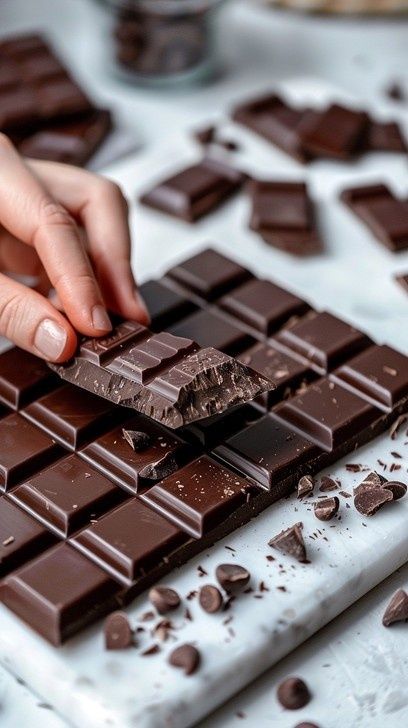
A fine chocolate bar announces its quality before it reaches the palate. Press a square between the fingers and it gives way with a precise, resonant break, neither dull nor crumbly but clean and confidently crisp. That small sound is more than an indulgent ritual. It is audible evidence that the chocolatier has controlled the invisible architecture of cocoa butter with unusual care. For readers curious about how luxury chocolates achieve crisp structural integrity, the answer begins at a scale far smaller than the finished confection.
Cocoa butter is not merely a smooth fat that carries cocoa solids and sugar. It is a sophisticated crystalline material whose molecules can assemble in several different arrangements. At room temperature, the right arrangement gives chocolate firmness, shine, and resistance to deformation. Near body temperature, that same structure yields rapidly, allowing aroma and flavor to unfold in a silky, almost vanishing melt. The pleasure of fine chocolate therefore rests on a delicate compromise between physics and sensation, carefully maintained in every polished shell, molded bar, and hand-finished praline.
The Polymorphic Nature of Cocoa Butter Triglycerides
The essential building blocks of cocoa butter are triglycerides, molecules formed from glycerol joined to three fatty acids. Cocoa butter is composed primarily of three characteristic triglyceride families known as POP, POS, and SOS. The letters indicate the fatty acids attached to the glycerol backbone: palmitic, oleic, and stearic acids. Their proportions and molecular shapes give cocoa butter its distinctive melting behavior, but the story does not end with composition. The same molecules can pack together in more than one geometric arrangement.
This phenomenon is called polymorphism. A polymorphic substance has an identical chemical composition in each form, yet its molecules occupy different crystal lattices. In cocoa butter, those arrangements are commonly identified as Forms I through VI. The differences are microscopic, but their consequences are visible and tactile. A lattice with loose or imperfect packing produces a soft, unstable chocolate, while a more ordered arrangement creates mechanical strength, a reflective surface, and a controlled melting point.
- Form I is soft, unstable, and associated with a low melting point.
- Forms II and III offer progressively greater firmness but remain unsuitable as the principal structure of premium chocolate.
- Form IV is useful during tempering as an intermediate crystal population.
- Form V provides the preferred balance of hardness, gloss, snap, and melt.
- Form VI is highly stable but develops slowly and can contribute to aging-related textural changes.
The geometric alignment of these triglycerides determines how efficiently neighboring molecules support one another. That microscopic cooperation becomes macroscopic rigidity. A well-tempered bar resists fingerprints, holds a sharp molded edge, and breaks along a clean plane because its crystalline network distributes stress evenly. The bar”s apparent simplicity conceals an intricate material structure, shaped by heat, time, movement, and the skill of the person who controls them.
Mapping the Six Crystal Forms from Fragile to Resilient
The six forms can be understood as a progression from relatively fragile, low-melting arrangements toward increasingly stable structures. Exact melting points vary with cocoa butter composition, processing history, and the presence of sugar, milk fat, cocoa solids, or other ingredients, so the figures below are best treated as practical ranges rather than rigid boundaries. A useful overview of cocoa butter morphology is available in the food science review Crystal Morphology of Cocoa Butter, which connects thermal behavior and microscopic structure with the appearance and texture of confectionery.
| Crystal form | Approximate melting range | Practical character |
|---|---|---|
| Form I | About 17°C | Very soft and highly unstable |
| Form II | About 23°C | Soft, weak, and short-lived |
| Form III | About 25°C | Firmer, but still prone to transformation |
| Form IV | About 27°C | Relatively stable intermediate structure |
| Form V | About 33 to 34°C | Glossy, firm, crisp, and ideal for confectionery |
| Form VI | About 36°C | Most stable, slow-forming, and associated with aging |
Form V, also called beta-2 or βV, is the gold standard because it balances room-temperature strength with a melting threshold close to human body temperature. It is stable enough to support a polished finish and clean handling, yet not so refractory that the chocolate lingers as wax on the tongue. Form VI is thermodynamically more stable, but stability alone is not the desired measure of eating quality. As Form V gradually transforms toward Form VI during prolonged storage, chocolate may become harder, less lively in its melt, or more vulnerable to visible fat bloom.
Form V Crystals and the Triple Crown of Snap, Gloss, and Melt
The famous snap of tempered chocolate begins with the dense packing of Form V crystals. When a bar is bent, the ordered network resists deformation until the applied force exceeds the strength of the crystalline structure. Fracture then travels quickly through the chocolate, producing a sharp acoustic signal. An indistinct bend or a sandy break often suggests that the crystal network is incomplete, uneven, or dominated by less desirable forms.
Gloss arises from the same discipline at the surface. A uniform population of Form V crystals encourages cocoa butter to solidify into a relatively even outer layer. That smooth surface reflects light in a coherent, specular manner, creating the deep shine associated with carefully tempered chocolate. A mottled or streaked appearance, by contrast, indicates that fats have migrated or that multiple crystal populations have formed without sufficient uniformity.
The final achievement is the melt. Form V typically melts around 33 to 34°C, close to the temperature of the mouth. This is a remarkable sensory calibration. At room temperature, the chocolate remains firm enough for a clean bite and elegant presentation. Once placed on the tongue, it softens quickly and releases cocoa aromas, fruit notes, roasted nuances, and spice. The contrast can be recognized through several sensory cues:
- Snap reveals structural strength and a coherent internal lattice.
- Gloss reflects a smooth, orderly surface with minimal crystallization defects.
- Melt reveals whether the chocolate dissolves cleanly or leaves a greasy, waxy residue.
- Finish shows how efficiently the fat carries aromatic compounds across the palate.
Untempered or poorly tempered chocolate may feel oily because its fat phase softens unevenly and coats the mouth rather than dissipating. Properly tempered chocolate feels silky, then disappears with surprising speed. That clean dissolution is not simply a matter of high cocoa content or expensive ingredients. It is the sensory expression of a carefully balanced crystalline network.
The Path of Tempering and How Form V Takes Root
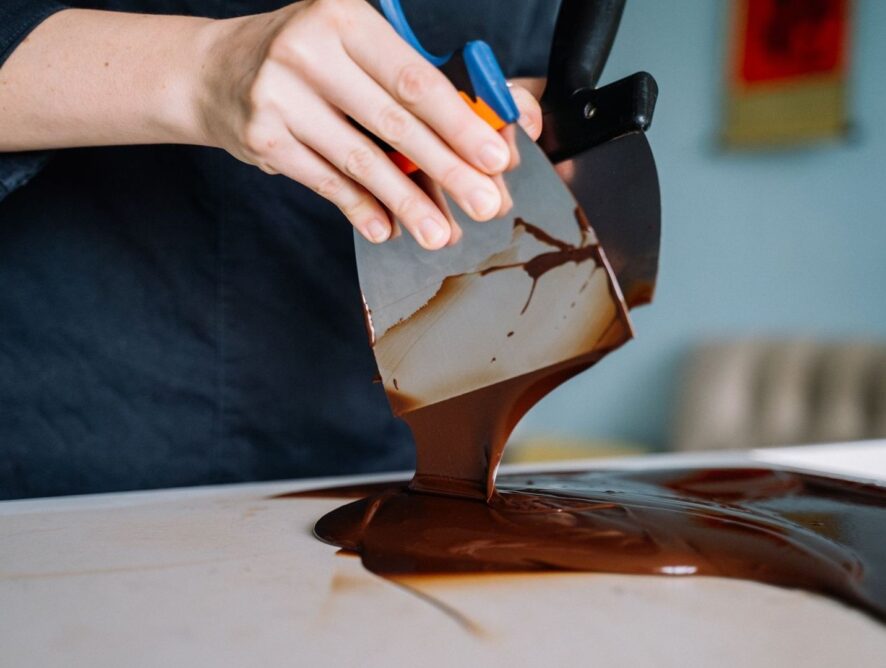
Tempering is a controlled thermal cycle designed to erase undesirable crystals, encourage the formation of useful nuclei, and retain a predominance of Form V. The chocolate is first heated sufficiently to melt existing crystal structures. It is then cooled while being mixed or agitated, allowing new crystals to form. Finally, it is gently reheated to remove unstable Form IV crystals while preserving the more desirable Form V seeds.
The technique may be performed with pre-formed seed chocolate, a method valued for its precision, or through a marble slab technique in which cooling and agitation are used to initiate crystallization. In both approaches, temperature alone is not enough. Movement distributes the developing crystals through the liquid chocolate, while shear stress promotes more uniform nucleation. A chocolatier is therefore managing both heat and flow, creating conditions in which the preferred lattice can spread through the entire batch.
- Melt thoroughly to remove the existing crystal history, using a temperature appropriate to the chocolate type.
- Cool while agitating to encourage the formation of stable seed crystals and distribute them evenly.
- Reheat gently to eliminate unwanted lower-melting forms without destroying the Form V population.
- Work consistently during molding, dipping, or coating, since excessive heat can undo the structure and excessive cooling can cause premature setting.
Dark chocolate is commonly worked near 31 to 32°C after tempering, while milk and white chocolate require lower working temperatures because milk fat and other ingredients alter their thermal behavior. A reliable thermometer is essential, but visual and tactile checks also matter. Properly tempered chocolate should set with a polished surface and firm edge, rather than remaining tacky or developing dull streaks.
When Geometry Breaks Down and Fat Bloom Occurs
Crystal systems are always moving toward greater thermodynamic stability. Over time, cocoa butter can reorganize from the desirable Form V structure toward Form VI. This transformation does not happen instantly, and it is not always a sign of poor craftsmanship. Even well-tempered chocolate may change during long storage, particularly when exposed to warmth, vibration, or fluctuating temperatures.
Temperature swings accelerate the problem. When chocolate warms, portions of its fat phase soften and begin to migrate through tiny channels in the solid matrix. As the chocolate cools again, that cocoa butter can reach the surface and recrystallize in a less uniform arrangement. The result is fat bloom, seen as pale gray or whitish streaks, patches, or a dusty film. The appearance can be disappointing, but fat bloom is generally harmless and the chocolate remains safe to eat, although its snap and mouthfeel may be diminished.
Sugar bloom has a different cause. Moisture from humid air or condensation dissolves sugar at the surface. As the water evaporates, the sugar recrystallizes into a rough, grainy coating. Fat bloom tends to look smooth or waxy, while sugar bloom feels noticeably gritty under the tongue. Both conditions are best prevented through stable storage rather than corrected after the fact.
- Store fine chocolate in a cool, dry environment, ideally around 15 to 18°C.
- Protect it from direct sunlight, radiators, ovens, and other sources of radiant heat.
- Keep it tightly wrapped or sealed to limit moisture and prevent the absorption of surrounding aromas.
- Avoid repeated movement between a warm room and a cold refrigerator, which encourages condensation and thermal cycling.
- If refrigeration is unavoidable, seal the chocolate carefully and allow it to return to room temperature before opening the package.
These habits are particularly important for filled chocolates, whose creams, nuts, and fruit preparations may have different storage requirements from a solid bar. Thoughtful handling preserves not only the visual finish but also the intended sequence of sound, resistance, melt, aroma, and aftertaste.
Savoring the Chemistry Behind Every Clean Break
Tasting fine chocolate becomes more rewarding when the crystalline structure is treated as part of the experience rather than an invisible technical detail. Begin with the appearance. Look for a consistent, reflective surface and crisp molded edges. Listen for a clean snap when the piece is broken. Notice the initial firmness between the teeth, then allow the chocolate to warm gradually on the tongue rather than chewing immediately. The speed and cleanliness of the melt reveal how successfully the Form V structure has been formed and preserved.
What appears to be a simple confection is, in fact, a carefully engineered encounter between molecular geometry and human physiology. A glossy surface, resonant break, silky texture, and elegant finish are the signatures of cocoa butter arranged with intention. Whether selecting a thoughtful gift or evaluating a bar for a pastry kitchen, attention to these details offers a more discerning way to recognize mastery: not only in the origin of the cocoa or the balance of sweetness, but in the quiet architecture that makes every perfect break possible.
